Set your training goals and budget
A useful home gym begins with the sessions a household can realistically fit into its week, not with a shopping list. A clear spending limit helps separate essential equipment from upgrades that can wait. For a home gym under 500, the aim is a small collection of items that supports regular training without taking over the room.
Choose the workouts you want to prioritize
The equipment should match the workouts that are most likely to happen. Someone focused on strength might prioritise weights and a stable surface for floor exercises, while a person who prefers brisk circuits may want a skipping rope or room for bodyweight movements. Choosing one main training focus makes it easier to avoid buying several pieces that all serve the same purpose.
Decide how much space you can dedicate
A spare corner, a garage bay and a shared living room each place different limits on equipment. Measure the usable floor area and consider whether gear must be packed away after every session. A repeatable setup beats a crowded one: compact equipment is often the more practical choice when the workout area also needs to serve another purpose.
Reserve part of your budget for essentials
The full amount should not be committed to the first piece of equipment. A mat, a modest storage solution or delivery can make a setup safer and easier to use, and these costs are easy to overlook when comparing prices. A simple spending order keeps those smaller needs in view:
- Choose one main piece that supports the preferred training style.
- Add a compact item that expands the range of exercises.
- Allow for a mat or basic floor protection if needed.
- Keep a small reserve for delivery, replacement parts or price changes.
That reserve is not wasted money; it gives the plan room to adapt if an item costs more than expected. Any remaining amount can stay unspent until a regular routine reveals what is genuinely missing.
Account for flooring, storage, and delivery costs
Equipment is only part of the total cost. A floor covering may be useful for grip and to protect a surface, while a basket or shelf can keep small items together without requiring a dedicated rack. Before ordering, check delivery charges and whether large or heavy items need to be carried into the home.
Choose versatile equipment for your setup
Versatile equipment can support more than one movement and is easier to fit into a modest budget. The best combination depends on the goal, the available space and the user’s comfort with each type of training. It is worth comparing the options as a group rather than assuming that every home gym needs the same core pieces.
Start with adjustable dumbbells or a set of fixed weights
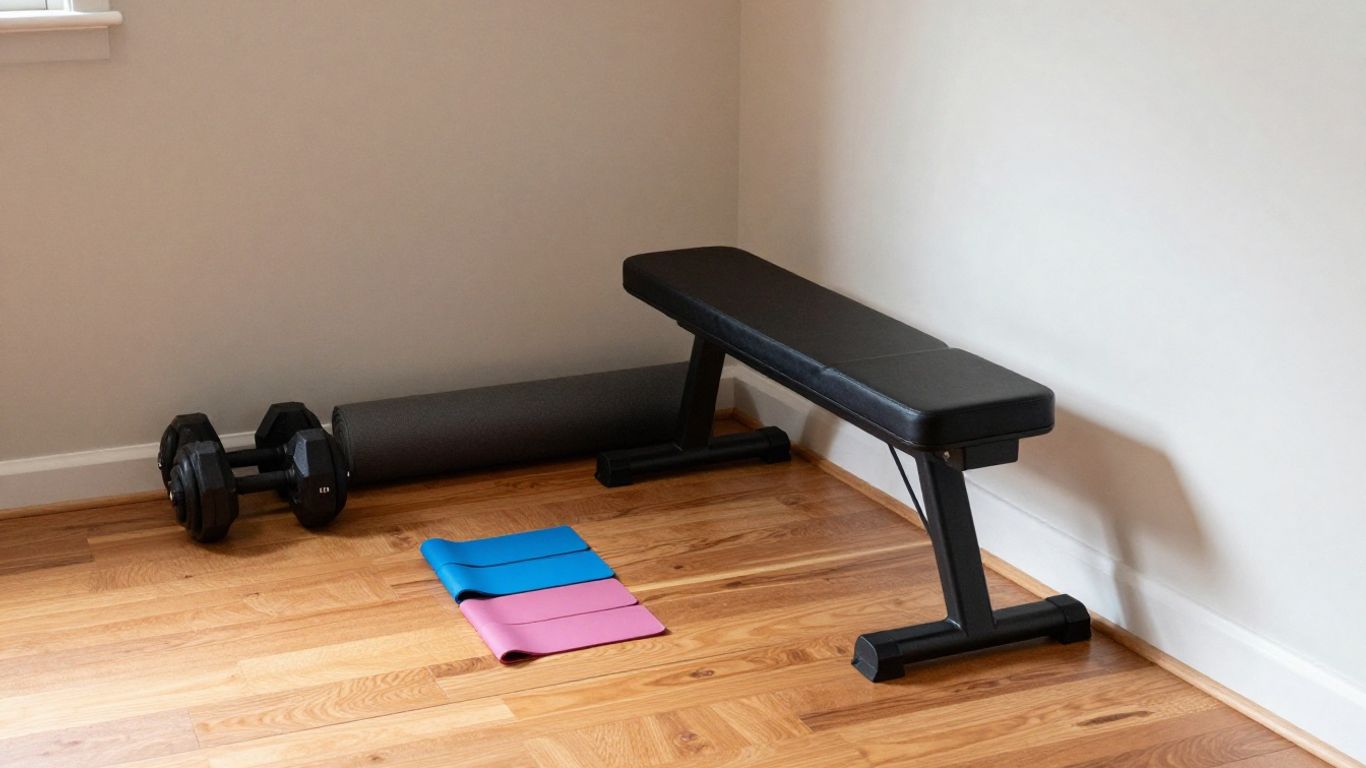
Adjustable dumbbells can provide several resistance levels in a relatively compact form, though the initial cost and adjustment mechanism deserve a close look. Fixed weights are straightforward to pick up and use, but a useful range may take more room and money. Either option can support presses, rows, squats and hinges when the load suits the person exercising.
Compare resistance bands, suspension trainers, and bodyweight options
Bands are light, easy to store and can add resistance to many movements; their feel and resistance range vary, so the intended exercises matter. Suspension trainers use bodyweight and an appropriate anchor point, which means the mounting location and its suitability should be checked before use. Bodyweight sessions need little equipment, but still benefit from enough clear floor space and a stable surface.
Add a bench only if it supports your workout plan
A bench earns its place when it makes planned exercises more comfortable or practical, such as supported rows or seated presses. It can also be useful for step-ups, provided the model is designed for that use and remains stable. If floor exercises and standing movements already cover the routine, the money and storage space may be better spent elsewhere.
Check weight limits, adjustability, and durability
Specifications matter more than an attractive price or a long list of features. Check the stated weight limits, locking or adjustment mechanisms, the condition of contact points and the maker’s instructions for use. A piece that feels secure and is easy to adjust is more likely to suit regular sessions than one that is awkward to set up or uncertain under load.
Build a sample equipment plan under $500
A sample budget is most useful as a framework, not a promise that the same prices will be available everywhere. Costs vary by location, timing, condition and delivery, so the figures below are planning allowances rather than quoted prices. The final mix should reflect the workout plan and the space it has to fit.
Create a strength-focused setup
For a simple strength setup, one adjustable dumbbell set can act as the anchor purchase, with bands and a mat adding exercise options without requiring a large footprint. An optional secondhand bench may suit someone whose plan includes bench-supported movements. The following allocation leaves the plan below the stated ceiling, while making room for price variation:
| Item or allowance | Planning amount | Role in the setup |
|---|---|---|
| Adjustable dumbbells | $250 | Main resistance option |
| Resistance bands | $30 | Additional resistance and variations |
| Exercise mat | $40 | Floor-based work and surface protection |
| Used bench, if suitable | $100 | Support for selected exercises |
| Delivery or contingency reserve | $60 | Covers variable costs |
| Planned total | $480 | Leaves some room below $500 |
These figures are illustrative allocations, not current market prices, and a bench can be left out if it is not part of the routine. If weights cost more in the local market, the plan can be adjusted by buying fewer items or using bodyweight movements while saving for a suitable option.
Put together a compact, low-cost option
A smaller setup can centre on a mat, a set of bands and one pair of fixed weights, with walking or bodyweight sessions providing variety without more equipment. This approach suits people with limited storage or those who are still learning which activities they enjoy. Starting with a few reliable basics also makes it easier to see what needs upgrading rather than guessing in advance.
Adapt the plan for cardio and conditioning
Cardio and conditioning can be built around activities that need little or no equipment, such as brisk walking, step patterns or bodyweight circuits. If the home has sufficient clearance, a skipping rope may be a relatively compact addition, but it is not suitable for every floor or ceiling height. A mat and a timer can support a simple circuit, while the budget remains available for strength equipment the person will use consistently.
Compare new, used, and secondhand equipment prices
New equipment offers the chance to check the condition and included parts before purchase, while secondhand options can make a higher-cost item more attainable. The lowest asking price is not necessarily the lowest total cost if collection, missing components or repairs are involved. Comparing options in a small table helps keep the decision grounded in the complete purchase:
| Buying option | Check before deciding | Possible trade-off |
|---|---|---|
| New | Price, specifications and included parts | May use more of the budget |
| Used locally | Condition, adjustment and collection details | Less certainty about past use |
| Secondhand from a seller | Completeness and whether it can be inspected | Availability and condition can vary |
A fair comparison includes the cost of getting the item home and making it ready to use. If an item cannot be inspected or its key specifications are unclear, a lower price alone is a weak reason to proceed.
Make the most of a small workout space
A home gym does not need a room of its own, but its layout should allow each movement to be performed without bumping into furniture or stored gear. A shared space benefits from equipment that can be moved and put away without turning setup into a chore. Planning the footprint first can prevent an otherwise useful purchase from becoming inconvenient.
Measure the area before buying equipment
Measure the floor area where exercise will actually take place, not just the gap where equipment might be stored. Consider the reach of the arms, the movement of a bench and the space needed to step back during exercises. A quick trial using tape on the floor can help show whether a proposed layout leaves enough room before any money is spent.
Protect floors and reduce noise
A mat or suitable floor covering can provide a more comfortable surface and help limit scuffs from equipment. It should lie flat and stay in place during movement; a curled edge can create a trip hazard. For shared homes, setting equipment down carefully and avoiding noisy movements at inconvenient times can make the space easier for others to live around.
Plan safe clearance around your workout area
The area should be clear of sharp corners, loose objects and unstable furniture before a session begins. The appropriate amount of space depends on the movement, so a standing exercise and a floor-based session may need different arrangements. A short setup check before each workout can help catch items that have drifted into the training area.
Store equipment where it is easy to access
A storage spot should make the equipment simple to put away and retrieve, without blocking a walkway or an exit. Small items can be grouped in a container, while heavier pieces should be stored securely and in a position that is manageable to lift. When the routine is easier to start and pack away, the equipment is more likely to remain part of everyday life.
Buy safely and avoid costly mistakes
A low price is useful only if the equipment is suitable and in serviceable condition. This matters especially when buying secondhand, where the seller may not know the item’s full history. Taking time to check construction and specifications can help avoid spending the budget on gear that cannot safely support the intended exercises.
Inspect used equipment before paying
For used weights, check for cracks, severe corrosion, loose parts or damage that could affect handling. A bench should sit firmly without rocking, and moving components should adjust and lock as intended. If a piece cannot be inspected in person, request clear details and images of the parts that matter, and be prepared to walk away if its condition remains uncertain.
Look for stable construction and clear specifications
The product information should state how the equipment is intended to be used and any relevant limits. For an adjustable item, check that the adjustment is secure and that all required pieces are present. Stability is not a feature to infer from appearance alone; if construction or instructions are unclear, another option may be more suitable.
Skip single-purpose gear you will rarely use
Specialised equipment can be appealing, but it may occupy space for only one occasional exercise. Before buying, consider whether the item supports several planned movements or fills a genuine gap in the routine. A plain, multipurpose piece is often more useful than a collection of accessories that are difficult to store and easy to ignore.
Leave room in the budget for replacement parts
Some equipment has small components that may wear or go missing, such as adjustment pins or attachments. Check whether those parts are identifiable and whether the seller or maker provides information about replacements. Keeping a modest reserve also helps prevent an unexpected repair or delivery cost from pushing the complete setup beyond its limit.
Set up a routine and expand over time
Equipment becomes valuable when it fits a routine that can be repeated around work, family and other commitments. For busy households, short sessions scheduled at a realistic time may be more practical than an ambitious plan that is repeatedly postponed. The initial setup can remain simple while the routine shows which equipment earns regular use.
Plan workouts around the equipment you own
A basic session can combine a lower-body movement, a push, a pull and a core exercise, using the equipment already available. The exact selection and workload should reflect the individual’s experience and comfort, rather than a template copied without adjustment. Keeping the plan easy to set up makes it more manageable when time is limited.
Progress with reps, resistance, and exercise variations
Progress can come from gradually adding repetitions, using a greater resistance when appropriate or choosing a more challenging variation of a movement. Changes should be deliberate, with enough attention to technique and control. There is no need to purchase a heavier or more complex item simply because a few sessions have become familiar.
Maintain and inspect equipment regularly
A brief inspection can reveal loose fittings, worn bands, damaged stitching or an unstable bench before the next session. Clean and store equipment according to its instructions, and avoid using any item that appears damaged or no longer adjusts securely. Regular checks are a small habit that can preserve the usefulness of a modest setup.
Add new gear based on your training needs
An upgrade should solve a limitation that has appeared in the actual routine, rather than a hypothetical problem. If a piece of equipment is used often and the person has outgrown its range, a replacement or addition may make sense; if it remains untouched, more gear is unlikely to help. Gradual purchases also preserve flexibility as household needs, space and training preferences change.
Conclusion
A home gym under $500 can be practical when its equipment reflects the workouts a person will genuinely do, fits the available space and leaves room for overlooked costs. Starting with a few versatile items, checking purchases carefully and building a repeatable routine keeps the setup manageable. New equipment can be added later when regular use reveals a clear need.
Frequently Asked Questions
The right setup depends on the household’s goals, available space and budget priorities. The answers below offer general starting points rather than a single plan for every person.
What is the most useful first purchase for a home gym?
The most useful first purchase is the item that supports the largest share of planned workouts. For some people that may be adjustable or fixed weights; for others, a mat and bands may be a more practical beginning.
Can a home gym fit in a small room?
Yes. Compact items such as bands, a mat and a small set of weights can be stored away between sessions, provided there is enough clear floor space to perform the chosen movements safely.
Is it better to buy adjustable or fixed dumbbells?
Adjustable dumbbells can offer multiple resistance levels in less storage space, while fixed weights are straightforward to use. The better choice depends on the budget, preferred exercises and available storage.
Should a beginner buy a workout bench?
A bench is worth considering when it supports movements included in the planned routine. If those exercises are not a priority, a bench may take up space and consume money that could be used for more relevant equipment.
Is secondhand workout equipment a good option?
Secondhand equipment can be a useful way to compare costs, but it should be inspected for damage, stability and missing parts. The full cost should include collection or delivery and any work needed before use.
How much space should be left around workout equipment?
There is no single clearance measurement for every exercise. The area should allow the intended movements without contact with furniture, walls or loose objects, and the layout should be checked again when equipment is moved.
How often should home gym equipment be checked?
Equipment should be checked regularly and before use if it has been moved, stored for a long time or used heavily. Loose fittings, damaged bands and parts that no longer lock securely are reasons to stop using the item until it is addressed.